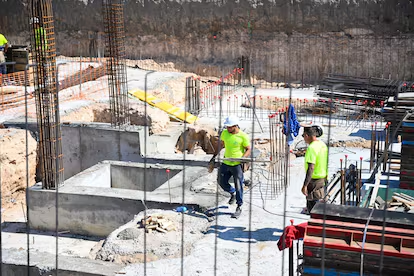
The question is not simply how many homes we need in Spain. The question is: which parts of our system are making it difficult to build within a reasonable timeframe? It is a systemic problem: a shortage of land, slow planning permission processes, high material costs, difficult access to finance, a lack of skilled labour, limited electricity capacity, water supply constraints, outstanding sanitation works and unimplemented external infrastructure…
Building in Spain is already difficult before the first brick is laid.
LACK OF DEVELOPABLE LAND
The biggest problem is finding urban land suitable for building, with a development plan in place, already parcelled out, ready for development or with utilities nearby. The Bank of Spain notes that the supply of new housing is limited by the shortage of ready-to-build land, the lack of skilled labour, production costs, material costs, energy costs, and the lack of investment in new urban land. Only 0.35% of available land is ready-to-build, and more than 74% remains undeveloped.
MUNICIPAL LICENCES AND ADMINISTRATIVE PROCEDURES
New residential developments require a technical design and a major building permit, and the Ministry of Housing itself acknowledges that these permits often involve a complex administrative process and years of waiting for approval. In 2025, the Ministry of Housing and Urban Agenda announced the “Guide to Recommendations and Best Practices regarding Planning Permits in the Residential Sector” to help all levels of government simplify and speed up the permit process.
COORDINATION BETWEEN ADMINISTRATIONS
A development project may involve the local council, the regional government, the river basin authority, coastal authorities, heritage bodies, roads authorities, environmental agencies, utility companies, the land registry, the cadastre, etc.
SHORTAGE OF SKILLED LABOUR
This is a very real shortage in the construction sector. It is noted that the lack of skilled labour is the main constraint on construction activity and that the number of unfilled vacancies has quadrupled between 2016 and 2024.
CONSTRUCTION COSTS AND MARGIN RISKS
Construction materials, insufficient industrialisation, wages, energy, supplies and subcontractors are driving up the cost of projects. It was estimated that direct residential construction costs rose by 5.5% in 2025 and that these costs account for approximately 80% of the total project cost. Furthermore, the conflict in Iran is exacerbating this situation in a worrying manner.
FINANCING AND PRE-SALES
A property developer typically requires land, bank financing, guarantees, pre-sales and sufficient profit margins. If land prices and costs rise, but buyers cannot absorb higher prices, sales become impossible. This has an even greater impact on social housing, where sale or rental prices are capped.
TECHNICAL, ENERGY AND ENVIRONMENTAL REGULATIONS
The Technical Building Code, accessibility, energy efficiency, waste management, acoustics, fire safety regulations, structural safety, external landscaping and utility connections all add to costs and complexity. These are not drawbacks in a negative sense, but they do influence timelines and budgets.
UTILITIES AND INFRASTRUCTURE
In summary: scarce land + slow licensing + lack of skilled labour + rising costs + difficult financing are the major obstacles. But these are compounded by other factors which, in many developments, are just as critical as planning permission. Without utility connections, electrical capacity, water and access, the land may be viable from a planning perspective, but in practice it cannot be built on. Utilities and infrastructure can block a development, even if the land and planning permission have been secured.
ELECTRICITY AND GRID CAPACITY: THE NEW SILENT BARRIER
A housing development needs to confirm whether there is sufficient electrical capacity for homes, garages, lifts, pumps, ventilation, communal areas, electric vehicle charging points, commercial premises and lighting. A study highlights that around 75% of network nodes are saturated or have no available capacity.
The most common problems:
- Lack of available power in the distribution network or the need to upgrade transformer stations, lines, substations or conduits.
- Delays in obtaining access and connection permits, particularly in large developments.
- The cost of electrical upgrades, which may ultimately be passed on to the developer or the compensation board.
- Lack of coordination between town planning, building permits, development projects and electrical planning.
- The risk of completing the works without being able to hand over homes due to a lack of connection, certificates or final supply.
WATER SUPPLY
The second major risk is that the area does not have a guaranteed supply of drinking water. It is not simply a matter of a pipe running nearby. It is necessary to check flow rate, pressure, reservoirs, pumping stations, water treatment, hydrants, concessions and the capacity of the municipal system.
Problems:
- Lack of available water resources, particularly in areas experiencing water stress, along the Mediterranean coast, on islands, or in municipalities experiencing rapid growth.
- Unfavourable or conditional reports from the water company, local council or river basin authority.
- The need for new reservoirs, pumping stations or pipelines, which can significantly increase the cost of the development.
SEWAGE, WASTEWATER TREATMENT AND STORM WATER
A development project may also be held up if there is insufficient capacity to discharge sewage and storm water. This affects sewers, pumping stations, storm water tanks, sustainable urban drainage and discharge permits.
- Insufficient or non-existent sewerage network.
- Need for pumping stations and subsequent maintenance.
- Outdated combined sewer systems.
- Risk of flooding and the obligation to implement sustainable urban drainage systems.
- Discharge permits or conditions imposed by the river basin authority.
URBAN INFRASTRUCTURE AND GENERAL SYSTEMS
In addition to utilities, a development may depend on external works that the developer cannot always control: access roads, public transport, street lighting, telecommunications and pipework, green spaces, facilities, schools or amenities. It is estimated that only 20% of potential residential land has adequate transport links.
IN SUMMARY
Spain does not just need more housing developments. It needs a greater actual capacity to produce housing. This means speeding up the process of making land available for development, reducing administrative delays, coordinating urban planning with electricity and water networks, strengthening the workforce, making affordable housing a reality, and ensuring infrastructure is in place before construction begins.
The question is no longer just how many homes Spain needs. The question now is: Which part of the system is slowing down the construction of new homes within a reasonable timeframe? Building homes does not depend solely on developers and construction firms. It depends on the entire ecosystem functioning in a coordinated manner.
In 2025, around 137,000 homes were started and around 92,000 were completed, including both private and social housing, according to data from the Ministry of Housing. Against this backdrop, the cumulative shortfall since 2021 is estimated at around 730,000 homes, and it is estimated that some 330,000 completed homes per year would be needed over five years to absorb the existing shortfall.
The Bank of Spain puts the cumulative shortfall for 2022–2024 at 400,000–450,000 homes, with a possible additional shortfall of over 100,000 in 2025. If the aim is to correct the cumulative shortfall, the challenge is even greater. Spain would have to complete approximately 3.5 times more homes per year than in 2025.